- Home
- /
- SOC 2
SOC 2

Loading
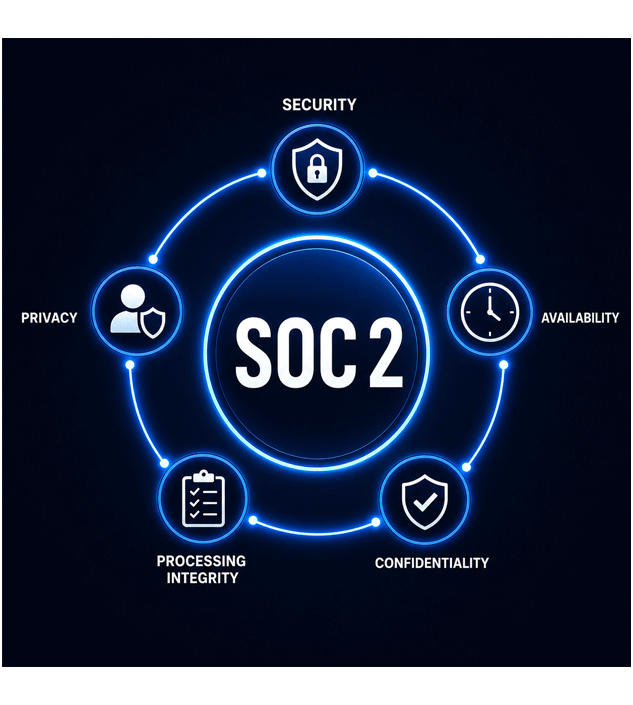
Globally recognized best practice, SOC 2 provides the rigorous assurance framework service organizations need to demonstrate that their systems and controls protect customer data effectively. Developed by the American Institute of Certified Public Accountants (AICPA), it helps service providers continually evaluate and strengthen their control environments, building trust with clients and prospects through independent third-party attestation.
Achieving a SOC 2 report demonstrates your organization’s commitment to maintaining robust controls over the security, availability, and confidentiality of client data.
By obtaining independent auditor attestation that your systems meet the Trust Services Criteria of SOC 2, you can inspire confidence in your ability to protect sensitive customer information, support enterprise procurement requirements, and differentiate your services in competitive markets where data security and privacy assurance are increasingly mandatory.
Organizations pursue SOC 2 reports to provide verifiable, third-party assurance that their internal controls adequately protect the customer data entrusted to them. In today’s cloud-first environment, technology and SaaS companies, managed service providers, and data processors routinely handle sensitive client information, making structured control attestation an essential component of business operations and enterprise sales.
A primary reason for pursuing SOC 2 is risk assurance and customer confidence. SOC 2 evaluates controls against five Trust Services Criteria: Security (the foundational category), Availability, Processing Integrity, Confidentiality, and Privacy. Organizations choose which criteria apply to their services, allowing a targeted and relevant assessment. The resulting report provides clients with detailed, auditor-verified evidence of the control environment, reducing the need for costly and time-consuming individual security questionnaires.
SOC 2 also supports enterprise sales and contractual requirements. Large enterprise clients, regulated industry customers, and government agencies routinely require service providers to hold a current SOC 2 Type II report as a prerequisite for procurement and contract execution. Without attestation, organizations risk losing competitive opportunities to compliant alternatives, regardless of the technical quality of their services.
Trust and market differentiation are significant motivators. A SOC 2 Type II report — covering a sustained audit period of typically six to twelve months — provides prospective clients with evidence that controls are not only well-designed but operating effectively over time. This distinction between design and operational effectiveness is critical for clients assessing the reliability of service providers in high-stakes environments.
The SOC 2 process strengthens organizational governance by requiring service organizations to document, implement, and continuously monitor their control environments. The audit process drives improvements in access management, change management, incident response, vendor oversight, and monitoring capabilities — producing internal security and operational benefits well beyond the attestation report itself.
Finally, SOC 2 promotes a culture of continuous improvement. Organizations typically pursue annual re-attestation to maintain a current report, creating a regular cycle of control assessment, gap remediation, and operational enhancement that keeps security practices aligned with evolving threats, client expectations, and emerging best practices.
Increasing reliance on cloud services, third-party data processors, and distributed technology supply chains is driving the need for greater transparency and independent assurance over the controls protecting customer data.
With a current SOC 2 Type II report in place, organizations can accelerate enterprise sales cycles, satisfy client due diligence requirements, and demonstrate a mature and continuously monitored control environment.
This includes effectively managing data security risks and client expectations, to opening doors to new enterprise relationships and regulated industry markets, regardless of organization size or service complexity.
Build a resilient, audited, and compliant control environment aligned with AICPA Trust Services Criteria.