- Home
- /
- Programs
Vulnerability & Patch Management

Loading
A structured, risk-based operational framework designed to proactively shrink your attack surface, enforce threat containment, and maintain continuous infrastructure stability.
Get an accurate inventory of your assets to know what systems you have across endpoints, networks, and cloud environments.
Determine which assets and vulnerabilities should be fixed first based on active exploits and the risk they pose to the business.
Deploy patches to protect production systems and services from exploitation while ensuring zero operational regression.
Report on your organization's patch posture, scan schedules, and track key remediation metrics to maintain compliance readiness.
The Clarent360 Vulnerability and Patch Management Program (VPMP) establishes a structured, risk-based approach to identifying, prioritizing, and remediating vulnerabilities across systems, applications, and services. The program enables organizations to minimize their attack surface while maintaining operational stability and compliance readiness.
The Vulnerability and Patch Management Program provides user-oriented operational guidance that integrates cybersecurity practices across business functions, technology environments, and governance structures.

Cyber threats continuously evolve — but most successful attacks still exploit known vulnerabilities. Our program incorporates leading global controls and standards to harden systems:
Alignment with CIS Control 7 (Continuous Vulnerability Management) and CIS Control 18 (Application Software Security) to continuously identify, classify, and patch security weaknesses.
Alignment with NIST Special Publication 800-40 Rev. 4 (Guide to Enterprise Patch Management Planning: Preventing Vulnerability Exploitation) for systematic planning and containment.
Through these standard-based protocols, Clarent360 helps organizations move beyond chaotic ad-hoc patching toward resilient architectures capable of mitigating threats systematically.
Organizations are expected to implement vulnerability assessment and patch deployment processes that operationalize industry-recognized secure practices throughout the operational lifecycle.
This includes continuous evaluation of:
Technical vulnerabilities across systems, endpoints, networks, and cloud environments
Patching workflows and testing protocols to ensure software and operating system stability
Governance oversight and policy enforcement metrics for remediation SLA compliance
Threat intelligence integration to identify active exploits and high-priority CVE risks
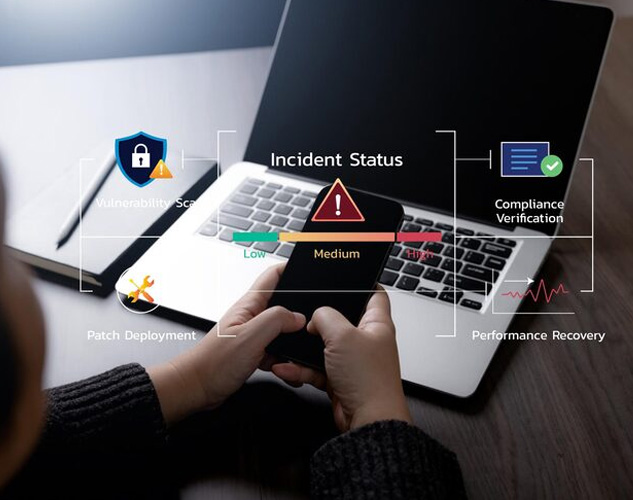
Clarent360’s approach ensures vulnerability management and patching requirements are embedded directly into day-to-day IT operations, configuration management, and system administration.
Integrate vulnerability scanning tools into continuous monitoring workflows
Operationalize risk-based prioritization using CVSS and threat intelligence
Establish clear remediation SLAs based on vulnerability severity
Align patch deployment schedules with minimal business disruption windows
Security and stability become foundational operational outcomes, preventing major service disruptions and security breaches.

The Clarent360 VPMP introduces management principles that ensure security patches are systematically identified, tested, and deployed across the entire enterprise IT landscape.
Clarent360 vulnerability and patch management specialists:
Advise IT and asset owners on scanning schedules and vulnerability remediation
Guide operations teams on system hardening and patch testing
Provide executive oversight and vulnerability dashboard reporting
Enable leadership accountability across Lines of Business (LOB) and asset owners

The VPMP delivers a comprehensive framework that ensures patching operations scale seamlessly alongside infrastructure expansion, cloud migration, and service scaling.
The program framework delivers a comprehensive roadmap for:

Clarent360 aligns enterprise patch management practices with leading compliance and security frameworks, including:
Organizations select the framework best suited to their operational environment, regulatory mandates, and threat profile while maintaining consistent remediation success.
Clarent360 supports organizations in building toward a maturity model that establishes:
Standardized monthly patching cadences
Automated discovery and internal asset mapping
SLA tracking and scanning coverage audits
Continuous optimization of discovery-to-remediation duration (MTTR)
Organizations adopting the Clarent360 Vulnerability and Patch Management Program achieve:
Reduced attack surface across all enterprise assets
Automated patch pipelines and testing environments
Improved regulatory and compliance readiness for global audits
Proactive mitigation of zero-day and active exploits
Operational stability with verified patch rollback safety
Stronger security posture and executive-level visibility
This program is ideal for:
Enterprises managing complex hybrid, on-prem, and multi-cloud infrastructure
Organizations subject to regulatory compliance frameworks (HIPAA, PCI-DSS, SOC 2)
Security Operations Centers (SOC) requiring high-fidelity vulnerability insights
IT and DevOps teams seeking to automate software and systems patch deployment
Organizations wanting to proactively reduce their external attack surface
Clarent360 integrates automated vulnerability scanning, intelligent risk prioritization, and systematic patch testing into a single unified capability — empowering your business to secure its digital footprint with minimal operational disruption.
👉 Engage Clarent360 to implement your Vulnerability & Patch Management Program.
Partner with Clarent360 to systematically identify, prioritize, and remediate security vulnerabilities across your IT landscape.